Home & organization
How to Choose a Shower Caddy That Fits, Drains and Is Easy to Clean
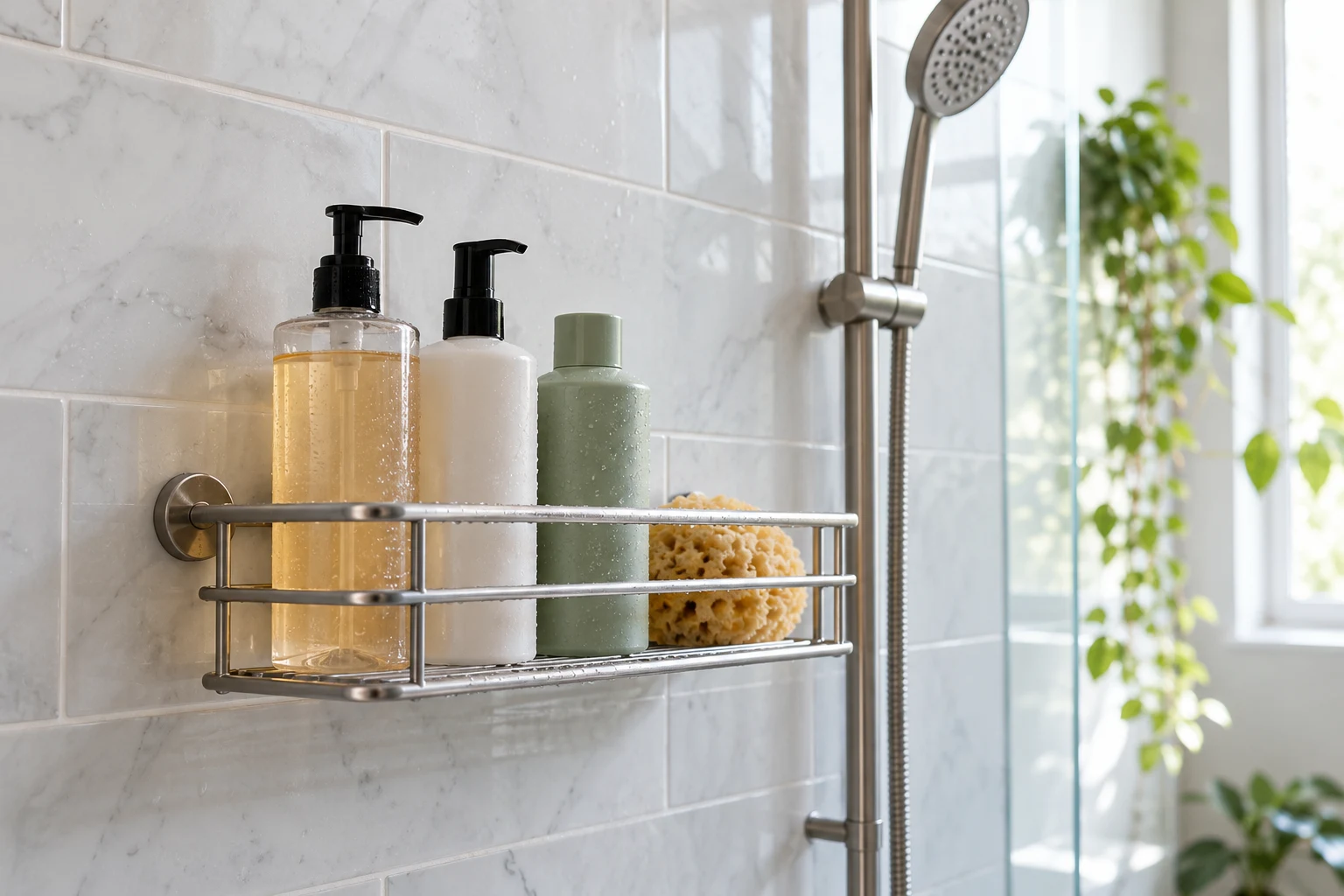
At a Glance
| Decision point | Useful choice | Trade-off to consider |
|---|---|---|
| Installation | Method compatible with the actual surface and support | Convenient-looking format without confirmed compatibility |
| Shelves | Clearance for real bottle movement | Capacity based on small demonstration bottles |
| Upkeep | Drainage plus accessible cleaning surfaces | More tiers that make ordinary cleaning harder |
Start with the bottles used every day
A shower caddy should make bathing supplies easy to reach while leaving the area straightforward to clean. It is not necessarily helpful to bring every spare bottle into the shower. Begin by separating daily products from occasional items and unopened replacements. Place the daily collection on a towel in the arrangement you would like to use. This gives you a practical idea of shelf space and shows whether you need one open level or several smaller groups.
Look at how each item is handled. A pump bottle may need vertical space above it, a short jar may be easier to use on an open shelf, and a small accessory may fall through a wide basket grid. These details are more useful than the total number of bottles a listing claims to hold. Choose around your actual products rather than a collection of matching sample bottles arranged for a photograph.
Measure the working area rather than a blank wall
Record the available width, depth, and height with taps, shower controls, doors, and other fittings in use. A caddy can fit against a wall yet interfere with a hand reaching a control or a door opening. Consider the approach from the position where you normally stand. If the shelf requires an awkward reach around another object, its apparent capacity will be less valuable during ordinary use.
Measure the tallest bottle with its pump in the working position. Leave room to lift a bottle out rather than just enough space for it to stand. If you prefer to operate a pump while the bottle remains on the shelf, check that the caddy is intended and installed for that use. Consider shelf spacing, the depth of any front rail, and whether the container can be placed securely within the manufacturer's loading guidance.
Compare hanging, tension, adhesive, and fixed formats
Different mounting formats suit different rooms and installation constraints. A hanging caddy may be convenient when a suitable support is available, but it should be compatible with the fixture and used according to its instructions. A tension system can provide several levels while occupying a vertical area, but its fit, contact surfaces, adjustment, and loading requirements need to match the room. Neither format should be selected solely because it avoids one type of installation work.
Adhesive shelves and mechanically fixed shelves have their own requirements. Check the exact surface compatibility, preparation method, load limit, and any waiting period or removal instructions. Do not assume that a product intended for one tile finish will work on every textured or painted surface. If you rent, confirm what installation is permitted. The correct format is the one that can be used as instructed in your bathroom, not the one that looks easiest in a short demonstration.
Think about drainage and access together
Open drainage can help water leave the storage surface, but it does not eliminate the need to clean the caddy. Look at where water can collect and whether the underside, corners, and contact points are accessible. A design with many narrow intersections can require more attention than a simple removable tray. Choose a form whose maintenance you can understand before it is installed against the wall.
The size of the openings matters for small items. A wide wire base can suit larger bottles and be inconvenient for a small razor accessory or compact jar. An insert may help, but adds another surface that needs cleaning and drying. Compare the complete arrangement rather than assuming one basket format handles every object equally well. If most of your items are small, a different shelf or a separate suitable holder may work better than adding several improvised liners.
Check materials through the exact product's instructions
A material label can be a useful starting point, but it does not tell you everything about the finish, fittings, joints, or care requirements of the complete caddy. Read what the maker says about the intended location and maintenance. Avoid interpreting a general appearance as proof that a shelf will remain unchanged in every bathroom condition. The installation points and smaller components are part of the product too.
Look for clear cleaning guidance and any restrictions on cleaning products or methods. If a finish needs particular care, decide whether that routine suits the household. A product that is theoretically easy to maintain can still be inconvenient when access is difficult. Think about how you will reach behind and beneath it and whether a tray or basket can be removed without disturbing the mounting system. Practical access makes the stated care routine easier to follow.
Size the caddy for a realistic loaded collection
A larger shelf can encourage more products to accumulate, increasing the load and making items harder to retrieve. Check the stated load limits and any instructions about distribution. Do not fill a caddy to a visually convenient level without considering the weight of full bottles. If several people share the shower, decide how the shelves will be used so that one person's collection does not block another's everyday items.
A small number of clearly accessible products can be more convenient than a dense arrangement that requires moving two bottles to reach a third. Store replacements elsewhere when possible. If the collection genuinely needs several levels, check whether the top and bottom shelves remain comfortable to reach and easy to clean. Total capacity is useful only when all of it can be used without awkward handling or disregard for the product's limits.
Consider what happens during cleaning
Imagine removing every item, cleaning the storage surface, and returning the collection. Does a rail trap the bottle bases? Can you reach the wall behind the shelf? Does a removable tray have somewhere to dry? These questions help distinguish a useful design from one that simply hides clutter. A caddy that is easy to load but difficult to empty can make routine cleaning feel like a larger task than it should be.
Do not assume the bathroom must be reorganized around a single large unit. A smaller shelf and a separate suitable holder may allow easier access, provided both are installed and used appropriately. Conversely, several small accessories can create more mounting points and corners than one well-chosen shelf. Compare the complete cleaning routine. The best arrangement depends on the shape of the room, the products stored, and the way you maintain the space.
Read reviews for installation-specific evidence
Look for accounts that identify the mounting surface and describe how the product was installed. A review that leaves out those details may be difficult to apply to your room. Check whether the writer used the same size and format. A tension unit, adhesive shelf, and hanging basket can have very different limitations even when they share a listing or brand. Favor information about the conditions of use over broad statements that a product is universally excellent or useless.
Repeated reports about shelf spacing, inaccessible cleaning areas, or unclear instructions can be useful prompts for further investigation. Distinguish product defects from situations outside the stated installation requirements. Confirm important measurements and compatibility directly with the seller or maker where possible. A customer photograph can show scale and layout, but it does not replace the instructions or establish suitability for a different wall surface.
Install carefully and assess the arrangement gradually
Follow the supplied directions in order, including preparation, adjustment, loading, and any checks specified by the manufacturer. Keep the packaging while assessing the fit within return conditions. Start with a limited representative collection and observe whether each item can be retrieved and replaced without disrupting the rest. Do not use an improvised installation merely because the caddy appears to stay in place during an initial check.
After normal use, look for the everyday inconveniences that a first impression can miss. Perhaps a pump is too close to the shelf above, a small item slips into a corner, or one bottle blocks the route to the controls. Change the layout if appropriate, or reconsider the product if the dimensions fundamentally do not work. An accessory should make the routine simpler rather than ask you to work around it indefinitely.
Worked example: a shared shower with tall pump bottles
In a shared shower, each person may use only a few products, yet the combined collection can overwhelm a small shelf. Start by removing replacements and occasional items from the daily area. Measure the remaining bottles with pumps extended, then decide whether broad open access or separate levels would be easier. Check that operating a pump or removing a bottle is consistent with the caddy's installation and load instructions.
If one shelf remains crowded, a larger caddy is only one possible answer. Different placement or a more suitable division of the everyday collection may work better, provided controls and access remain clear. Reassess after normal use and cleaning rather than filling the available shelves immediately. A practical design leaves room to lift objects, inspect surfaces, and maintain the installation as directed. It succeeds when both people can use and reset the space without moving each other's bottles, not when every possible product has been fitted into the photograph.
Choose a caddy that leaves room to use the bathroom
Prioritize compatible installation, accessible dimensions, a manageable load, and a cleaning routine you can follow. Only then compare extra hooks, decorative finishes, or a larger number of shelves. Those additions are useful when they support a real need, but unnecessary features can complicate a small space. The right purchase may be smaller than the unit that first caught your attention.
A successful shower organizer keeps daily products within reach without turning the area into a storage cupboard. It leaves the controls usable, the shelves understandable, and the surrounding surfaces accessible for cleaning. If those basic tasks are not improved, more capacity is not a meaningful upgrade. Choose the arrangement that makes an ordinary morning easier and remains manageable when the bottles are full, the room is in use, and cleaning cannot be postponed to a perfect organizing day.
Questions & Answers
Which shower-caddy mounting method is best?
Choose the format that is compatible with the actual room and can be installed as instructed. Hanging, tension, adhesive and fixed designs have different surface, support, loading and access requirements.
Does an open base remove the need to clean a caddy?
No. Drainage and cleaning are separate considerations. Check access to corners, the underside and the wall behind the unit, and follow the care guidance for the exact finish and fittings.
How much shelf clearance do pump bottles need?
Measure the actual bottle with the pump in use, and consider how you will remove or operate it within the product’s instructions. A bottle that merely stands on the shelf may still be inconvenient to handle.