Home & organization
How to Organize a Small Entryway Around Everyday Arrivals and Departures
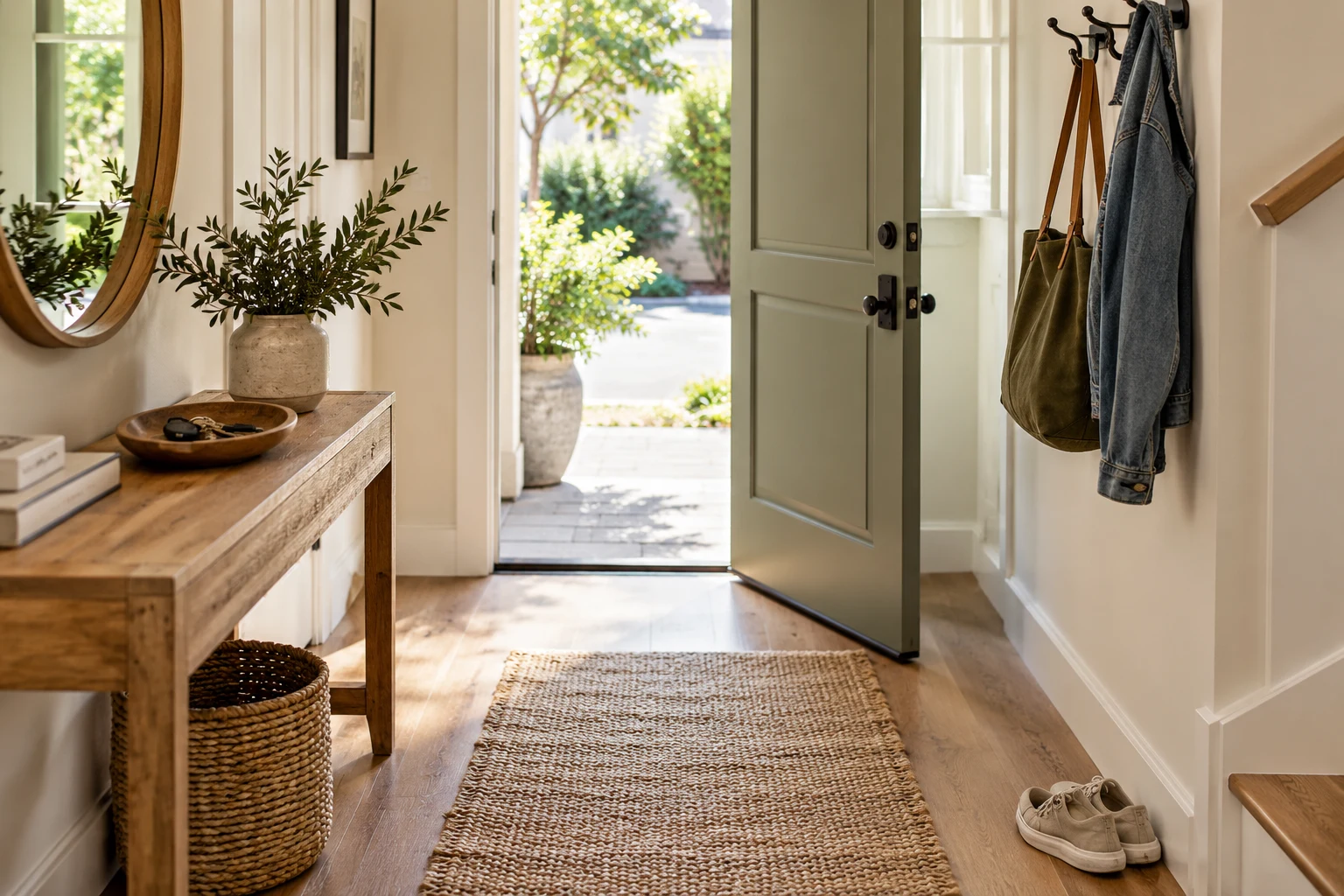
At a Glance
| Decision point | Useful choice | Trade-off to consider |
|---|---|---|
| Small objects | Visible convenient landing place | Drawers only when the action fits the routine |
| Bags | Suitable accessible mounting and clear walkway | Extra furniture without an established job |
| Outgoing items | Small temporary zone that is cleared | Large holding basket for unresolved decisions |
Organize the first minute after coming home
An entryway works when it supports the movements people already make. Keys need an obvious landing place, a bag needs somewhere convenient to rest, and shoes need a location that does not interrupt the route through the door. A large storage unit can be attractive while failing those basic tasks. Before shopping, observe the first minute after several ordinary arrivals. Notice what is put down, where it lands, and what must be moved to make room.
Turn those observations into a short list of jobs. You might need a place for keys and glasses, a hook for one everyday bag, and a small outgoing-items tray. Those needs do not automatically require a bench, cabinet, shelf, mirror, and several baskets. Start with the recurring inconvenience. A modest arrangement in the right place can be easier to maintain than a complete furniture set that makes the entrance feel crowded.
Protect the route before adding furniture
Measure the door swing and the clear path used when entering with shopping or luggage. Include nearby cupboard doors, radiators, and anything that must remain accessible. A console that fits against the wall can still narrow the space at the exact point where people turn. Mark its footprint on the floor and walk through the entrance carrying the things you normally bring home. The purpose is to test movement, not just the available wall length.
Depth is often more important than total storage capacity in a narrow hall. A shallow shelf or small tray may solve the key problem without occupying the floor. A deeper cabinet can make sense if it fits comfortably and stores a collection that otherwise blocks the entrance. Follow the manufacturer's installation and anchoring guidance for any furniture you choose. Do not trade an easy route through the room for storage volume that will rarely be useful.
Give keys and glasses an unmistakable home
Small frequently used objects benefit from a location that is visible, reachable, and easy to use with one hand. A tray can work well when you naturally put things on a surface. Hooks may suit a routine where keys remain attached to a loop or lanyard. Choose the format based on the action you are likely to repeat, not the appearance of a matching organizer. If putting an object away requires opening a small drawer every time, check whether you will actually do it.
Keep this landing place limited. Adding mail, receipts, loose change, chargers, and unrelated objects can turn it into another searching area. Decide what belongs there and what moves elsewhere. If several people use the entrance, make the arrangement understandable without a complicated labeling system. An obvious place for each person's everyday essentials can be useful, but too many tiny compartments may make resetting the surface more work than it needs to be.
Choose hooks for the actual bag and surface
A hook should suit the shape and weight of the item it will hold, as well as the surface where it is mounted. A narrow strap, a broad handle, and a coat can interact differently with the same hook. Check the product's load limits, installation instructions, and intended use. Consider the reach needed to hang and remove the item without brushing against other belongings or pulling an adjacent hook's contents down.
The fixing method is part of the purchase. Adhesive products, over-door fittings, and screw-mounted hooks have different requirements and limitations. Confirm surface compatibility and any restrictions in rented property. An over-door fitting may affect how a door closes, while an adhesive mount may require specific preparation and removal steps. Do not assume the simplest-looking installation is suitable for every wall or load. If the instructions do not support the intended use, choose another format.
Store the shoes you use, not the entire collection
The entrance usually works better when it holds the pairs currently in rotation rather than becoming the permanent home for every shoe in the household. Count the pairs that genuinely need to remain there. Then compare their dimensions with the proposed rack or cabinet. Boots, larger shoes, and bulky soles may fit differently from the small shoes shown in a listing. Check usable shelf height and depth rather than accepting a general pair-count claim.
Think about how shoes are put away when people are tired or in a hurry. A convenient open shelf can be easier to use than a closed cabinet, while a cabinet may better suit a room where appearance is a priority. Both choices have trade-offs in access, cleaning, and space. Choose the arrangement whose everyday action is simplest for the household. If shoes repeatedly remain beside the unit, the opening, location, or capacity may be wrong.
Decide whether a bench earns its footprint
A bench can be useful when someone regularly sits to put on or remove shoes. It may also create a temporary place for a bag. However, a bench that becomes a permanent pile has lost those functions. Decide which task justifies the floor space and keep the seating area available for it. If nobody uses a seat during the normal routine, a shallow storage solution may be a better fit.
Check the bench's dimensions, intended load, and any assembly or anchoring requirements. Consider access to storage beneath a seat or behind a door. A lift-up top may be inconvenient if the surface is usually covered, while open lower storage may be easier to reach but more visible. Evaluate the complete working arrangement, including what happens when two people arrive together. Furniture that looks spacious when empty can feel restrictive during a busy departure.
Create a separate outgoing zone
Items waiting to leave the house need a different role from objects stored permanently at the entrance. Returns, library books, documents, or something to take to work can benefit from a small temporary zone. Choose a location you naturally see before leaving, and keep it limited enough that it is reviewed rather than ignored. A tray or basket is a reminder mechanism only while its contents remain visible and relevant.
Clear the outgoing zone regularly. If it becomes long-term storage, split the process: objects awaiting a decision belong elsewhere, while things genuinely ready to leave can stay by the route out. Do not buy a larger basket as the automatic response to a full one. A growing collection may reflect unfinished decisions rather than insufficient capacity. The entryway should support the handoff between home and the outside world, not become a holding area for every unresolved household task.
Make cleaning part of the layout
Entrances can collect dust, outdoor debris, and moisture carried on belongings. Choose surfaces and removable components you can maintain according to their instructions. Check whether the floor remains reachable beneath or around furniture. A dense arrangement of small baskets and narrow gaps can make a quick clean unnecessarily difficult. It is worth leaving accessible space when that makes the room easier to reset.
Look at the storage from the perspective of moving it or emptying it. Can you lift the key tray without spilling small objects? Can a shoe shelf be reached without dismantling a pile? Are cleaning instructions clear for the material and finish? A visually tidy arrangement that is difficult to maintain may gradually become less inviting. Simpler shapes and a limited collection often make the useful routine easier, although the right choice depends on the entrance and the belongings stored there.
Test the arrangement before buying the whole system
Use an existing tray, a temporary marked footprint, or a suitable piece of furniture to test the location. Watch what happens over a normal week. If keys still land elsewhere, ask whether the new place is outside the natural route. If bags block the passage, check whether the hook is hard to reach or already occupied. These observations can prevent an expensive purchase that formalizes an arrangement people do not use.
After adding one useful component, reassess before expanding. The smallest successful solution may already address the main problem. Matching accessories can be pleasant, but they should not create categories or tasks that were not needed. Keep the entrance understandable to visitors and other household members. The system should work without one person continuously correcting where everything belongs.
Worked example: an entrance used by two people
Suppose two people arrive with keys, a work bag, and occasional shopping. One broad tray may initially seem sufficient, but the bags soon cover the small objects. Instead of buying a larger console immediately, separate the functions: a clearly visible location for small essentials and an appropriately installed place for the everyday bags. Keep the walkway and door swing in view while testing the arrangement.
After a week, look at what still lands elsewhere. If outgoing documents become mixed with keys, give ready-to-leave items a small distinct zone. If bags remain on the floor, check whether the storage is occupied, inconvenient, or unsuitable for the handles. The answer may be changing one location rather than adding furniture. A shared entrance works when each person can understand the arrangement and reset it without supervision. This practical test is more revealing than deciding that every household needs the same combination of bench, cabinet, hooks, baskets, and decorative tray.
Choose for the busiest ordinary moment
Picture the household leaving with bags, putting on shoes, and looking for keys. That moment is the best test of the design. Choose a layout that keeps the route clear, the everyday objects easy to reach, and temporary outgoing items visible. Favor furniture and fittings whose installation and maintenance suit the room. When the arrangement works during a rushed morning, its appearance becomes a welcome addition rather than the only reason it was purchased. A useful entryway saves searching and rearranging; it does not need to store the whole house.
Questions & Answers
What should I buy first for a small entryway?
Begin with the most repeated inconvenience, such as misplaced keys or a bag left in the walkway. A small well-positioned tray or suitable hook may solve it without a complete furniture system.
How do I know whether a bench is worth the space?
Test whether someone regularly sits to put on shoes and whether the seat can remain available. Check the working footprint with doors open and people arriving together, rather than judging the bench in an empty room.
Why does the entryway become cluttered again?
The location may interrupt natural movements, the storage may be inconvenient, or temporary outgoing items may have become permanent. Observe where objects land and adjust the routine before buying more capacity.