Everyday essentials
How to Choose a Lunch Bag for Your Containers, Commute and Cleaning Routine
At a Glance
| Decision point | Useful choice | Trade-off to consider |
|---|---|---|
| Meal layout | Bag sized for containers and appropriate cooling | Capacity chosen before the meal is planned |
| Transport | Format fitting the actual commute and main bag | Extra structure that makes the load awkward |
| Care | Accessible seams and clear cleaning instructions | Pockets and inserts that add unnecessary maintenance |
Choose the lunch bag after planning the meal
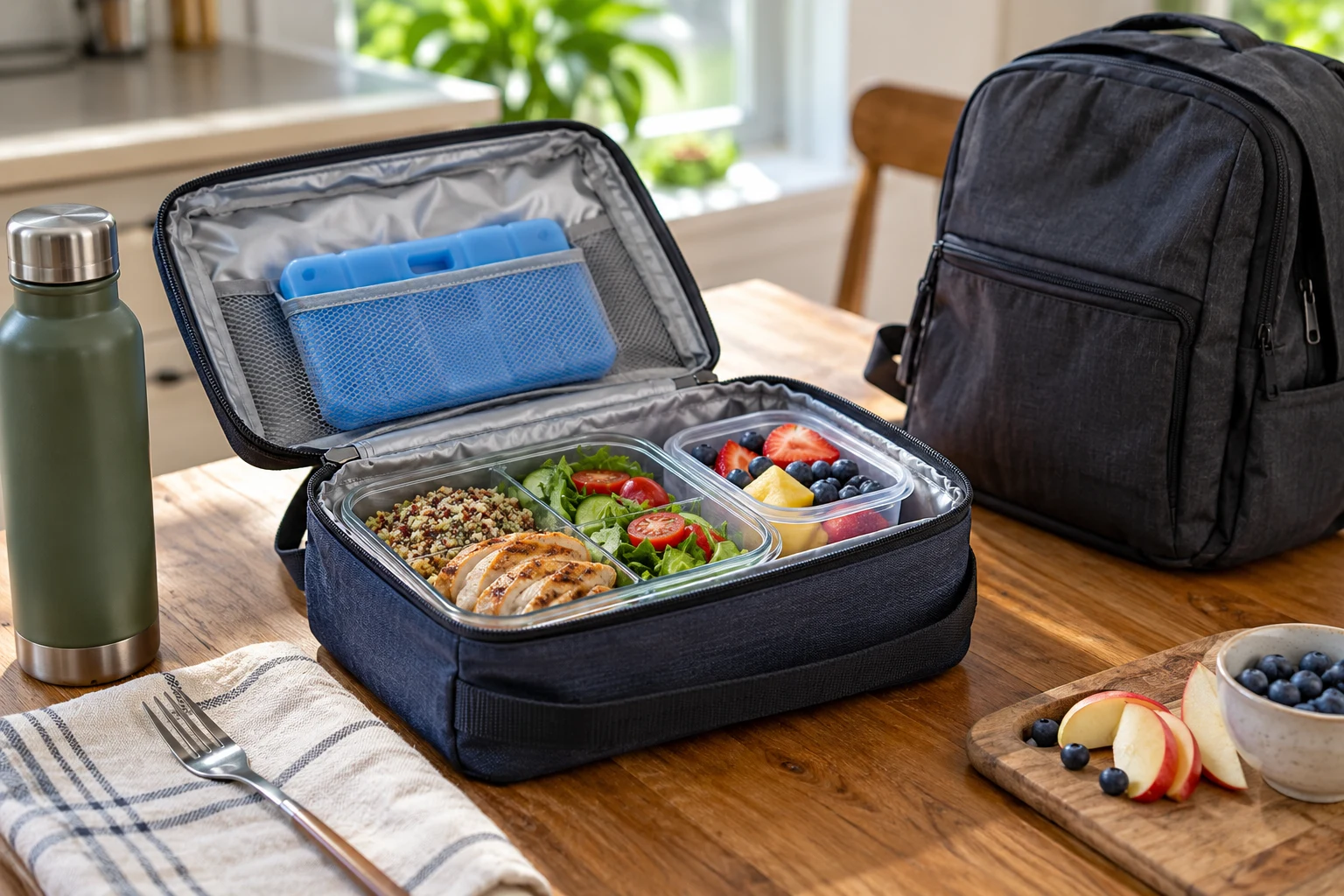
A lunch bag should fit the meal you carry, the way you travel, and the storage available at your destination. Starting with the bag can lead to containers that do not sit upright, a drink that crowds the main meal, or a bag too large for the backpack you use every day. Lay out a typical packed lunch first. Include the actual containers, any utensils, the drink if it travels in the same bag, and the cooling arrangement appropriate for the food.
That layout gives you a meaningful footprint and height to compare. It also reveals whether you need one open compartment, a separate pocket, or a different container arrangement. Do not buy around an unusually large meal unless that is a regular requirement. A bag that is convenient for ordinary lunches is more useful than one with impressive capacity that you avoid carrying because it is bulky on the commute.
Separate insulation from food-safety planning
An insulated bag can be part of transporting a meal, but insulation alone does not establish that a particular food remains at a safe temperature. Appropriate cooling, transport time, the food itself, and storage after arrival all matter. Consult reliable food-safety guidance for the kind of lunch you pack. Do not replace that guidance with a product photograph, an unqualified retention claim, or the assumption that any bag labeled “insulated” handles every situation.
If a refrigerator is available at work or another destination, plan how and when you will use it. If the bag remains with you, think through the entire period before the meal is eaten rather than just the time spent traveling. This guide helps compare bags and everyday access; it does not prescribe safe storage times or temperatures for a particular meal. The USDA's packed-lunch guidance is a useful place to check the food-handling side separately from the purchase decision.
Measure the loaded arrangement
Measure the combined meal setup rather than adding the advertised capacities of individual containers. Lids, handles, rounded corners, and the way containers nest beside one another affect the space needed. Include room to lift the main container out without tipping it. A wide opening can be valuable when you carry a substantial lunchbox, while a tall narrow bag may suit a different arrangement. The bag's usable interior is more informative than its outside dimensions alone.
Leave space for the cooling method appropriate to your lunch. A bag that fits the meal only when completely full may not support that arrangement. Also check whether the opening is smaller than the base. Some bags look spacious in a photograph but narrow near the zipper, making a rigid container awkward to insert. If the listing is unclear, ask for usable dimensions or choose an option whose fit can be established before ordering.
Compare soft-sided and structured designs
A flexible bag can be easier to fit beside other belongings or store when empty. Its shape may change when loaded, so consider whether your containers remain in the orientation you intend. A structured design may make packing and access more predictable, but takes up more space and can be awkward inside another bag. Neither format is automatically better; the choice depends on how the lunch travels and where it sits during the day.
Check the base and opening with the full layout in mind. If you often set the bag down while opening a door or using a travel card, see whether the loaded arrangement remains stable in the intended position. Do not infer leak resistance or upright stability from the appearance of a product alone. Read the exact bag's and containers' instructions. A well-matched combination reduces the need for careful balancing at each stage of the commute.
Choose handles and straps for the actual route
A short carry handle may be sufficient for a trip from home to a car and then a nearby refrigerator. A longer walk or public-transport journey can put more importance on a shoulder strap or the ability to place the bag inside your regular backpack. Test the combined carrying plan. A lunch bag that feels manageable by itself may be inconvenient when you also have a laptop, umbrella, shopping, or other everyday items.
Look at how handles and straps attach and whether adjustment is useful for your clothing and carrying style. Consider access while the bag is being carried. A pocket that cannot be reached without putting everything down may not solve the problem you imagined. If you intend to clip or attach the bag to another item, check the product's intended use rather than assuming a decorative loop is designed to carry the loaded bag in that way.
Inspect cleaning access before the first spill
The inside of a lunch bag should be understandable to clean. Look at seams, corners, folds, and any removable liner or insert. Follow the manufacturer's care instructions; do not assume the whole bag can be machine washed because the lining looks wipeable. A wide opening can make it easier to inspect the interior. A complicated shape may offer useful organization but create more areas that need attention after use.
Think about drying and storage as part of the routine. A bag that folds very compactly may still need to remain open until properly dry after cleaning. If a removable insert is included, check how it fits and whether spills can travel underneath it. You want a process that is easy to complete on a normal evening. If cleaning is awkward enough that you postpone it, the bag is a poor match regardless of how neatly it holds the containers.
Decide which extra pockets have a job
An external pocket can be useful for utensils, a napkin, or small items that should remain separate from the main meal. It is less useful if you fill it with things that are rarely needed and make the bag bulky. List the objects that require a separate home, then check the pocket dimensions and closure. A large pocket count is not an advantage when the pockets cannot hold the items you carry.
Be careful about counting the same space twice. Filling an outside pocket may reduce the usable room beside a soft main compartment or change the overall shape. Check the bag when all intended compartments are in use. If your water bottle already has a convenient home in the work bag, a dedicated bottle holder on the lunch bag may be unnecessary. Choose features that simplify the whole load rather than duplicating functions you already have.
Compare the real cost of the system
A bag and container bundle may be convenient, but evaluate the individual pieces. The containers should match your portions and care routine, while the bag should suit the route and storage plan. Do not accept an awkward container simply because it is included. Conversely, a modest bag that fits your existing reliable containers may be a sensible purchase. Compare the cost of the complete arrangement you will actually use.
Check replacement availability for any proprietary insert, strap, or special container on which the system depends. Availability can change, but knowing the present arrangement helps you judge the purchase. Read warranty and return terms directly. A low headline price offers limited value if the bag does not fit your daily meal or cannot be assessed within a practical return process. The useful comparison is ownership, not the apparent number of accessories in the listing.
Read customer accounts with your lunch in mind
Look for reviews that describe similar containers, carrying routes, and cleaning needs. A user packing small snacks may have a very different view of capacity from someone carrying a rigid lunchbox. Check which size or version is being reviewed. Photographs can be helpful when they show actual contents, but they are not proof of temperature performance or suitability for your meal. Keep food-safety verification separate from general customer satisfaction.
Recurring observations about zipper access, interior dimensions, handle attachment, or hard-to-clean areas are worth investigating. Distinguish a mismatch from a construction problem, and ask the seller or maker when an important specification remains unclear. You are looking for evidence about the task you need the bag to perform. A star average cannot tell you whether your largest container passes through the opening without tilting.
Worked example: a lunch bag inside a work backpack
If the lunch bag travels inside another bag, test the combination with the laptop and normal accessories in place. The lunch bag should pass through the opening and be retrievable without forcing unrelated belongings out. A separate outside drink pocket may be unnecessary if the backpack already provides a suitable location. Compare a flexible lunch bag and a more structured one with the actual meal arrangement rather than assuming that extra structure always improves carrying.
At the destination, check how the meal moves into the planned storage location. A bag that must remain fully assembled to hold its shape may be inconvenient if containers are removed and returned during the day. After the meal, think about what comes home and how the empty bag is cleaned and dried. This sequence helps you choose a useful opening, footprint, and care routine. The right size is the one that supports those tasks and the appropriate handling of the food, not simply the largest capacity that fits in the shopping basket.
Run a full-day routine test
Pack a normal lunch with the appropriate storage and cooling plan. Carry it alongside your usual belongings, retrieve the main container, and put everything away afterward. Then follow the bag's care instructions and check how it dries and stores. Notice the stage that takes extra effort. A bag that fits perfectly on the kitchen counter may still be inconvenient when opened beside a crowded desk or carried through a busy station.
Choose the smallest practical arrangement that supports the actual meal and its handling requirements without forcing a tight fit. Prioritize access, cleaning, and a carrying method you will use willingly. Keep the packaging while assessing fit within the return conditions. A good lunch bag becomes an unobtrusive part of preparing and carrying a meal; it should not require you to redesign every lunch around the shape of the bag you bought.
References
Questions & Answers
Does an insulated lunch bag guarantee safe food storage?
No. Appropriate handling depends on the food, cooling arrangements, time and storage available. Consult reliable food-safety guidance separately; a general insulation claim does not determine the safety of your particular lunch.
Should I choose the lunch bag or containers first?
Lay out the actual meal containers and the appropriate cooling arrangement first. Measure the combined footprint and height, then choose a bag whose usable interior and opening make loading and retrieval straightforward.
What is the most commonly overlooked ownership issue?
Cleaning and drying deserve attention before purchase. Inspect corners, seams, liners and care instructions, and consider how the bag returns from lunch to a clean, dry and ready-to-use state.