Kitchen
How to Choose Food Storage Containers That Fit Your Meal Routine
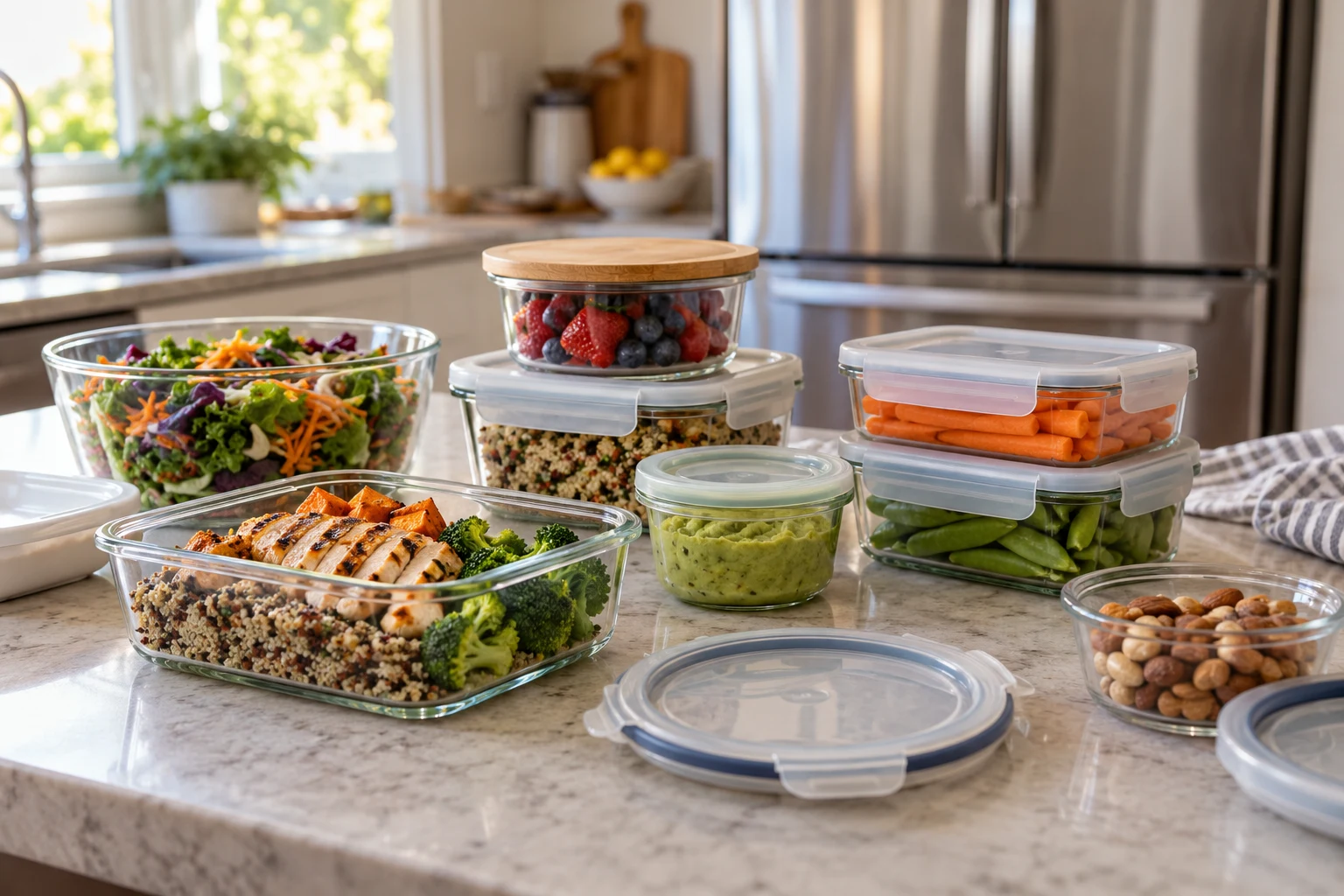
At a Glance
| Decision point | Useful choice | Trade-off to consider |
|---|---|---|
| Portions | Repeatable sizes used in ordinary meals | Large assortment with many unused pieces |
| Lids | Clear component instructions and compatible replacements | More closures than the household can easily maintain |
| Empty storage | A practical nesting and lid arrangement | Compactness that makes useful pieces hard to retrieve |
Build a container system around actual meals
Food storage containers should make the transition from cooking to storing, carrying, serving, and cleaning straightforward. A large assortment is not automatically a useful system. The practical question is whether the sizes and lids match what you prepare during a normal week. Start by noticing the leftovers and packed meals you already handle. A single serving of pasta, half a batch of soup, and a cut ingredient may need different shapes, but that does not mean every task needs a separate proprietary container.
Make a short list of the sizes you reach for most often. Include the containers that are always missing when you need them and the ones that sit unused at the back of the cupboard. This reveals whether you need replacements, a few additional medium sizes, or a simpler collection with fewer lid types. Buying another mixed set before doing this can leave you with more pieces and the same shortage of useful containers.
Compare useful portions rather than piece counts
A set's advertised piece count may include both bodies and lids, so read the listing carefully. What matters is the number of complete containers in sizes you will use. Check whether the largest piece fits your refrigerator and whether the smallest pieces serve a real purpose. Several tiny tubs may look generous in a bundle but contribute little if your main need is carrying a normal lunch portion.
Use your existing meals as a guide to shape and capacity. Rectangular containers can make sense for a shelf arrangement, while another shape may suit the food or serving method you prefer. Capacity alone does not describe the footprint, depth, or ease of reaching the contents. Compare the full dimensions with your refrigerator, bag, and storage cupboard. A slightly smaller container that fits all three may be more useful than a larger one that complicates the rest of the routine.
Decide what you need from the material
Different container materials bring different handling and care requirements. Rather than choosing by a universal claim that one material is best, list your intended uses and check the exact product's suitability. Consider weight when carrying lunch, visibility in the refrigerator, and whether you prefer to serve directly from the container. Read the manufacturer's instructions for both the body and the lid, since the complete set may have different limitations from its most prominent component.
Avoid assuming that a familiar appearance establishes compatibility with heating, freezing, or a dishwasher. Labels and instructions for the exact model matter. If the container is intended for a use that involves particular temperature conditions, follow the guidance on changes in temperature and handling. Where the listing is ambiguous, ask the maker or choose a product with clearer information. An uncertain feature should not become the basis of a daily meal routine simply because the container looks similar to one you have used before.
Treat the lid as an ownership feature
The lid determines how quickly you can close a container, how much attention cleaning requires, and whether the system remains useful if a small part is lost. Simple press-on lids may suit easy everyday access, while locking closures can have additional hinges, clips, or seals. Neither format guarantees suitability for every use. Check the exact product's carrying and closure instructions rather than assuming that a particular visual style establishes leak resistance.
Inspect how seals are removed and replaced, if removal is part of the care instructions. Ask whether replacement lids or seals are sold for the model. A body that remains perfectly usable is less convenient when its special lid is unavailable. If several sizes use interchangeable lids, confirm which sizes actually share them. The benefit is practical: finding a matching lid quickly can matter more than owning an impressive assortment of differently shaped containers.
Check reheating, freezing, and dishwasher use separately
A container can be suitable for one purpose and unsuitable for another. Check the body's and lid's instructions independently for every use you expect. Follow any requirements for venting, lid removal, placement, or temperature changes. Do not assume the phrase “food storage” includes oven use or that a dishwasher-compatible body means the lid belongs in the same position or cycle. Clear guidance reduces uncertainty during busy meal preparation.
Food handling is a separate question from container compatibility. A product's material or closure does not determine how a meal should be cooled, stored, transported, or reheated. Use reliable food-safety guidance appropriate to the food and situation. This guide compares container ownership and layout; it does not establish safe storage times or temperatures for a particular meal. If you need those details, consult the relevant public guidance rather than a retailer's lifestyle photograph or a general review.
Plan refrigerator space with filled containers
Look at the shelves as they are normally used, including the bottles and ingredients that remain there. Check whether a filled container can slide into place without rearranging several other items. Stacking may help, but access to the lower container still matters. A uniform footprint can simplify the arrangement, provided the capacities suit your portions. Do not select matching shapes solely for appearance if they leave large amounts of unused room around the food.
Visibility is useful when it helps you remember what is available. Clear sides can assist, but the label and placement may matter more when containers are stacked behind other items. Develop a simple way to identify the contents and relevant preparation information without creating a complicated labeling project. The aim is to make a meal easy to find and use. If a container repeatedly disappears behind a taller one, change the layout rather than assuming more storage pieces will help.
Make the empty system easy to store
A container system spends part of its life empty. Check whether bodies nest and how lids are kept together. Deeply nested pieces can save space but may be inconvenient if they are difficult to separate or if different sizes must be moved to reach the one you use daily. A slightly less compact arrangement can be more practical when it allows a complete container to be taken out quickly.
Give lids a defined location that supports how you unload and pack them. You might keep a limited set together or separate lids into a small accessible organizer. Avoid collecting incompatible pieces indefinitely. If a lid or body is missing, decide whether a replacement is available and worthwhile. A cupboard full of incomplete sets is a sign to simplify the collection, not a reason to buy another large assortment without reviewing what is already there.
Inspect cleaning access before buying
Look at corners, rims, clips, and seals. A smooth body may be straightforward to clean while a complicated lid requires more attention. Check how the parts are dried and whether you can inspect hidden areas as directed by the maker. Choose a cleaning process that fits your routine rather than assuming an inconvenient design will become easier because the set looks coordinated.
Pay attention to the tools and storage space cleaning requires. A lid with several small parts can be manageable if you are comfortable handling them, but frustrating if those pieces are difficult to keep together. A large container may be awkward in a small sink even when it is useful in the refrigerator. Think about the entire cycle from dirty container to dry, reassembled set. That cycle will repeat far more often than the initial unboxing impression.
Use a normal lunch as the acceptance test
Pack the meal you actually take, place the container in the intended bag, and check how it is carried within the product's instructions. Can you remove it without tilting the whole bag or moving several other items? Does it occupy the space reserved for a drink or cooling arrangement? A container and a lunch bag should be evaluated together, because a useful size in the refrigerator can be inconvenient during the commute.
After use, clean and store the complete set according to the care directions. Notice whether one stage creates friction: finding the lid, reaching a corner, drying the seal, or making space in the cupboard. Use that observation to guide the next purchase. The best system is one you can repeat without special effort. It may consist of fewer containers than a large bundle offers, but those containers will earn their place through regular use.
Worked example: leftovers that become tomorrow's lunch
Imagine cooking a meal for dinner and saving two portions. One portion will stay in the refrigerator, while the other travels to work. A single very large container may store both efficiently at first, but then requires another transfer when packing lunch. Two suitable meal-sized containers may reduce that step, provided they fit the refrigerator and the travel bag and are used according to their instructions.
Now consider cleaning and storage the following evening. If both containers share a convenient lid format and fit the cupboard, the system remains easy to repeat. If they introduce two new proprietary closures into an already mixed collection, the apparent convenience may disappear. Compare the complete cycle rather than only the moment food is first put away. This example also explains why buying a few well-chosen sizes can be more useful than a large set: the valuable pieces are the ones that support a repeated meal routine without extra transfers, searching, or awkward storage.
Choose the complete routine over the biggest bundle
Prioritize the sizes that match your meals, the lids you can operate and maintain, and clear instructions for the uses you need. Compare the total cost of useful complete containers, not the apparent price per piece. Check the exact variant before ordering and keep packaging while assessing the fit within return conditions. A modest, compatible collection can make meal storage easier without filling the cupboard with spares. When the routine works from packing to washing to putting away, the container system is doing its job.
Questions & Answers
Is a larger mixed container set the best starting point?
First identify the portions and sizes you use most. A large set can introduce unused small pieces and incompatible lids. Compare complete useful containers rather than the advertised total piece count.
Can I treat the body and lid as having the same limits?
No. Check each component’s instructions separately for reheating, freezing, cleaning and any other intended use. Product material or appearance alone does not establish the limits of the complete set.
How can I simplify a cupboard full of lids?
Identify complete sets, check whether missing components can be replaced, and keep a limited collection of useful compatible sizes. Give lids a defined accessible location instead of adding another assortment without reviewing the existing pieces.