Home & organization
Kitchen Organizers: Measure, Compare and Choose What Actually Fits
At a Glance
| Decision point | Useful choice | Trade-off to consider |
|---|---|---|
| Shallow utensils | Adjustable dividers for visible groups | Fixed tray when its sections fit the collection |
| Deep cupboard | Lift-out bin for a group used together | Pull-out rack when installation and load suit the cabinet |
| Maintenance | Simple removable surfaces | More intricate designs only when the access benefit is worthwhile |
Start with the drawer that annoys you most
A kitchen organizer earns its place by making a repeated job easier. It should let you reach the spatula while dinner is cooking, find the correct lid without lifting a stack, or put groceries away without dismantling the shelf. A photograph of matching containers cannot tell you whether those jobs will improve. Before shopping, choose one awkward drawer or cupboard and describe the problem in a sentence. “I cannot reach the pan at the back” is a useful brief. “The kitchen needs organizing” is too broad to guide a purchase.
Empty that one space and group its contents by actual use. Keep everyday utensils apart from occasional baking tools. Set aside duplicates and anything that belongs in a different room. This is not a demand for a minimalist kitchen; it is a way to avoid paying for storage that preserves an inconvenient collection. Once the contents are visible, you can judge whether the problem is insufficient space, poor access, or simply too many unrelated objects sharing one location.
Measure the opening, the interior, and the movement
Three measurements matter more than the cabinet's advertised width. First measure the opening through which the organizer must pass. Then measure the usable interior, accounting for hinges, pipes, shelf supports, and the drawer mechanism. Finally check the space needed for movement: a basket must pull forward, a lid must lift, and a tall bottle may need room for its pump. A rack can fit inside a cupboard yet fail this third test every time you use it.
Draw a simple plan with the obstacles marked. For an under-sink cupboard, record the position of the pipes rather than treating the space as a clear rectangle. For a drawer, measure height with the drawer closed, including the tallest utensil you intend to store. Use cardboard or paper to represent the organizer's footprint. Open the cupboard door fully and slide the template through the opening. This inexpensive rehearsal often reveals a fit problem that product photographs conceal.
Match the storage format to the access problem
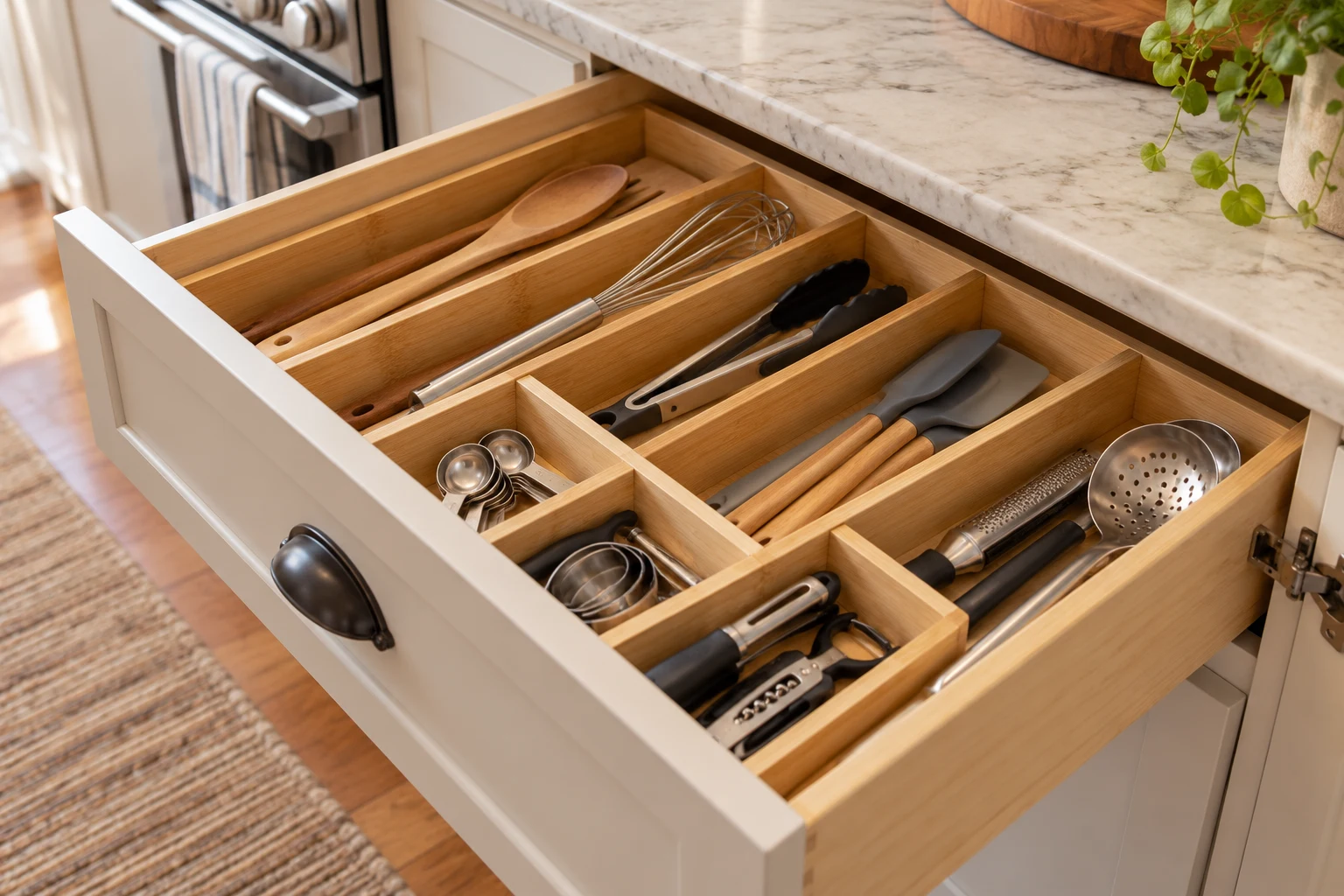
Dividers work best when you need to keep a shallow collection visible. They create boundaries without requiring you to lift a whole tray out. A fixed compartment tray is convenient when its sections correspond to your utensils, but an awkwardly sized compartment can waste room. Adjustable dividers offer flexibility, although their end fittings and minimum extension length still need to match the drawer. Check how they are secured and whether that method suits the surface.
Lift-out bins are useful for groups used together, such as baking supplies or sandwich-making ingredients. Pulling the entire group forward can be simpler than retrieving individual packets from a deep shelf. Shelf risers create a second level but may hide what sits beneath them or leave too little room for taller items. Pull-out racks address depth directly, yet bring installation, mounting, and load considerations. Choose among these formats by tracing the hand movement you want to improve, not by selecting the largest capacity.
Organize around cooking zones, not matching sets
Put the items used for a task close enough that you do not repeatedly cross the kitchen to collect them. This may mean keeping the frequently used mixing bowl near the preparation area while storing occasional serving pieces elsewhere. The exact arrangement depends on the room and the people using it. A household that cooks together needs more passing and working space than a kitchen usually used by one person. Your organizer should support that arrangement rather than impose a showroom layout.
Buying a large coordinated set can make the decision feel easier, but it often introduces pieces that do not solve a real problem. Start with the format needed for the difficult space. If it works, expand deliberately. Matching appearance is a reasonable preference once fit and access are settled; it is a poor substitute for them. Also consider whether another household member can understand the system without being told where every object belongs. A useful layout remains workable after someone else unloads the dishwasher.
Be realistic about installation and loaded weight
A free-standing tray, an adhesive holder, a tension divider, and a screw-mounted rack impose different requirements on a cupboard. Read the exact installation instructions and check that the mounting surface is suitable. If you rent, confirm what changes are permitted. Avoid assuming that an adhesive fitting and a mechanical fixing are interchangeable simply because the organizers have similar shapes. The intended surface, preparation method, load limit, and removal process all matter.
Assess weight with the expected contents included. A basket full of jars behaves differently from the same basket holding lightweight packets. Handles need clearance for your fingers, and the shelf itself must be appropriate for the load. Place heavy collections where they can be handled comfortably rather than at the highest available point. If a pull-out rack requires a substantial loaded section to move toward you, check the manufacturer's installation and loading guidance before deciding it is a convenient upgrade.
Choose surfaces and shapes you can clean
Kitchens collect crumbs, drips, and small spills. An organizer with a complicated grid may look light and open but take longer to wipe than a simple removable tray. Wood, coated metal, and plastic each have different care requirements, so follow the manufacturer's directions rather than relying on the material name. Consider how the organizer will be dried and whether the underside is accessible. A storage solution that cannot be lifted without emptying the entire cupboard adds a maintenance job.
For packets and small utensils, look closely at the base and the gaps. Thin items can fall through an open basket, while a deep solid-sided bin can hide them. A removable liner may help with one problem and create another if it traps debris in inaccessible corners. There is no universally best surface. Choose the design whose cleaning routine suits what you actually store, and make sure a person can reach the back of the cupboard after it is installed.
Compare complete solutions rather than headline prices
The useful comparison is the total arrangement needed to solve your problem. One rack may include fittings, while another requires separate hardware or additional baskets. An inexpensive set can become poor value when only one component fits. Conversely, a basic divider can be entirely adequate if the task is keeping a small utensil collection apart. Make a short list of non-negotiable requirements and compare those before considering extra compartments or a decorative finish.
Read reviews for evidence relevant to your situation. Look for photographs of the organizer in a similarly shaped drawer, comments about usable interior measurements, and descriptions of the mounting surface. Distinguish a defect from a mismatch: a reviewer who bought the wrong width has not necessarily established poor construction, but repeated reports of the same fitting issue deserve attention. Check the exact variant being reviewed. A listing covering several sizes can contain useful observations about a different product from the one in your basket.
Try a complete everyday cycle before committing
When the organizer arrives, keep the packaging while checking the fit. Install or position it according to its instructions, then begin with a representative selection rather than filling every compartment. Retrieve the largest item, replace it, close the door or drawer, and repeat the task with your hands occupied as they would be during cooking. Notice whether a handle catches, a bottle blocks the back row, or the divider shifts. These are practical reasons to change the arrangement.
Live with the system for several normal meals before expanding it. If objects repeatedly end up outside their assigned space, ask whether the location is inconvenient or the compartment is too restrictive. Do not respond automatically by buying more organizers. Sometimes the better solution is a shallower bin, fewer categories, or moving an occasional item to a different cupboard. The purchase has succeeded when everyday use becomes easier and resetting the space takes little thought, even after a busy evening.
Worked example: a deep cupboard for everyday cooking
Imagine a cupboard that holds a frequently used frying pan, two saucepans, spare lids, and a roasting dish used occasionally. The daily problem is removing the frying pan from beneath the other pieces. Adding a shelf riser might create separation, but it could also reduce the clearance for the largest saucepan. A lid organizer may help one category while leaving the main problem untouched. Begin by moving the occasional roasting dish to another appropriate location and testing the remaining layout.
If the pan can then be retrieved easily, you may need only a modest divider or nothing at all. If depth remains the obstacle, assess a suitable pull-out format against the cupboard's opening, installation requirements, and expected load. Compare that complete solution with the simpler option of relocating the daily pan to a more accessible cupboard. This example illustrates why the first decision should concern the task and location. Buying the most elaborate organizer first can obscure an easier improvement that costs less and remains simpler to maintain.
A sensible buying decision
Choose a divider when visibility and separation are the main problems. Choose a lift-out bin when several items are usually used together. Consider a pull-out system when depth makes otherwise useful storage inaccessible and the installation is suitable. Postpone the purchase when the contents have not been sorted or the usable dimensions remain uncertain. An organizer cannot compensate for a fundamentally unsuitable location. The strongest choice is often a modest piece bought for a specific job, tested in the actual kitchen, and expanded only after it proves useful.
Questions & Answers
Should I buy a complete matching organizer set?
Start with one difficult drawer or cupboard. A set is useful only when its individual pieces fit the measured spaces and the tasks you need to improve. Test a useful format before expanding.
Are pull-out racks better than lift-out bins?
Pull-out racks can address inaccessible depth when installation and loading are suitable. Lift-out bins can be simpler for a group used together. Compare the actual movement, mounting requirements and loaded weight.
What should I measure besides cabinet width?
Measure the opening, interior depth and height, obstacles such as hinges or plumbing, and the clearance needed to remove items or operate pumps. Closed dimensions alone do not describe usable access.