Home & organization
How to Choose Storage Bins for Easy Access, Not Just More Capacity
At a Glance
| Decision point | Useful choice | Trade-off to consider |
|---|---|---|
| Frequent retrieval | Shallow, visible groups | Deep lidded storage for occasional contents |
| Dense items | Smaller manageable containers | Large bins for suitable lighter collections |
| Tight shelves | Accessible opening and handle clearance | Top lid only when there is room to lift it |
Begin with retrieval rather than volume
Storage bins are easy to buy because capacity looks measurable. A large number on a listing suggests a simple solution to a crowded shelf. In practice, the more important question is whether you can find, remove, and replace the contents without creating another mess. A bin that holds everything but must be emptied to reach one object has solved containment and failed retrieval. Decide which job you need before comparing sizes.
Choose one collection rather than buying for the whole house at once. It might be seasonal bedding, cables, craft supplies, or the objects that have gathered on a hallway shelf. Sort that collection into groups based on when and how items are used. Frequently accessed supplies deserve a different container from belongings stored for several months. This step gives you a practical brief and prevents a coordinated set of bins from preserving an inconvenient mixture.
Separate keeping, grouping, and containing
An organizer cannot make an unwanted object more useful. Before measuring containers, decide what you intend to keep in the location. Put items that belong elsewhere to one side and identify duplicates. This does not require discarding useful possessions; it simply avoids measuring a storage solution around objects that will not remain there. Once the collection is settled, group pieces that are normally retrieved together.
Only then choose the container. For example, spare charging cables and current travel accessories may look similar but are used differently. The travel group might need to lift out as a kit, while the cable collection benefits from visible smaller compartments. Putting both into a deep box can turn every search into a sorting session. The right grouping reduces the work the bin must do and often leads to fewer, more appropriate containers.
Measure usable dimensions on both sides
Record the shelf opening, shelf depth, and vertical clearance. Account for door frames, hinges, brackets, and anything that narrows the route out. Then compare the bin's external measurements with the available space. Leave enough room to grip a handle or lift the lid. A container that fits exactly into the opening may be frustrating once it is loaded, especially when another bin sits beside it.
Next compare the bin's interior with the largest expected item. Tapered sides, thick walls, lid fittings, and rounded corners can reduce usable space. Capacity does not describe those shapes. If the listing provides only outside measurements, do not assume a flat document folder or large shoe will fit inside. Ask for clarification or choose a product with sufficiently clear specifications. A paper footprint helps test the shelf arrangement before you commit to several identical pieces.
Choose visibility deliberately
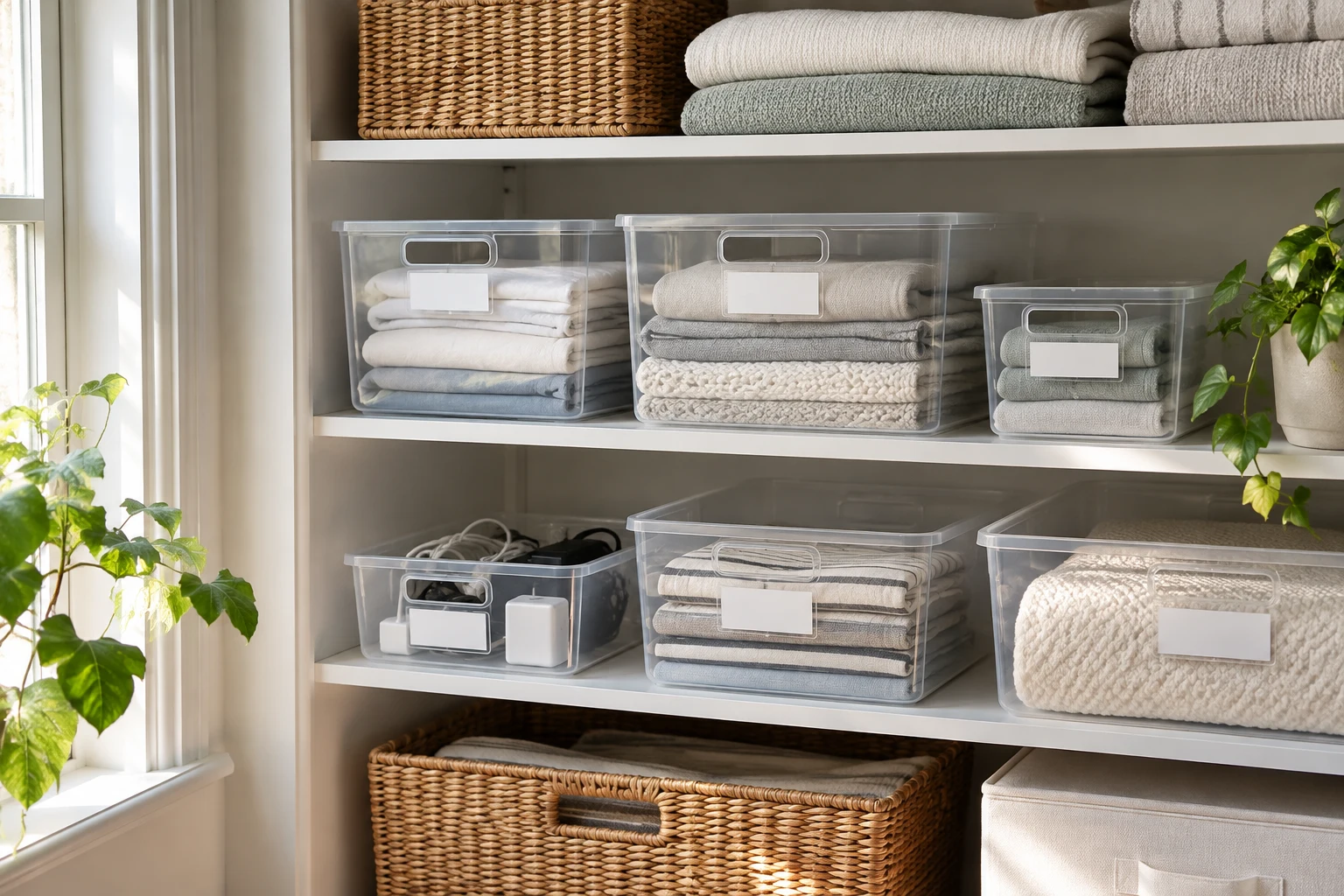
Clear bins make some contents easy to identify, but visibility is less helpful when many small objects overlap. A clear box filled with tangled cables can remain difficult to use. Opaque containers can reduce visual clutter in an open room, provided the labels are easy to understand. Choose based on how you will locate the contents rather than assuming clear or opaque is always better.
Labels should describe what you will search for later. “Winter scarves” is more helpful than the name of the room where you happened to pack them. Put the label on the side that faces the normal approach, and consider a second label if the bin can be turned around. Avoid creating so many narrow categories that you cannot remember where an item belongs. An understandable grouping works for other household members as well as the person who organized it.
Match lid access to the storage position
A removable top lid works well when there is room to lift it or when the entire container is taken down before opening. On a tight shelf, the same lid may require pulling out a heavy box every time. Front-opening designs can improve access in a stack, but check the opening size and the way the door or flap moves. A large container with a small opening may still prevent easy removal of its biggest contents.
Stacking is not automatically the best use of vertical space. Consider how often the lower container is opened and how many others must move first. Follow the manufacturer's stacking and load instructions, and check the supporting shelf or floor arrangement. If you access the bottom bin daily, a separate shelf or shallower containers may be more convenient than a tall stack. The aim is usable storage, not the maximum number of boxes in a photograph.
Think about the weight after loading
Large bins are tempting for dense items because they hold so much, but the loaded weight can make them difficult to handle. Books, tools, and collections of small hardware can become awkward long before the container is visually full. Divide dense contents into smaller manageable groups and place them where they can be reached comfortably. Check the container's intended use and the supporting furniture's limits rather than assuming a sturdy appearance establishes capacity.
Handles deserve a practical test. Look at their shape, attachment, and clearance when the bin sits between neighboring containers. Can you grip them while wearing the clothing you normally use in that space? Can the box be lifted without an awkward twist? A handle that works when a bin is empty may be uncomfortable under a realistic load. Keep heavy storage away from locations that require you to stretch and lift at the same time.
Consider cleaning and the storage environment
A container suitable for a dry bedroom shelf may not be appropriate for a different environment. Check the product's stated use and care instructions, especially for locations subject to moisture, dirt, or temperature changes. Do not assume an ordinary lidded bin is waterproof, airtight, pest-proof, or designed for outdoor storage. Those are specific claims that need to be established for the exact product.
Look inside the base and corners to judge how cleaning will work. A simple shape may be easier to wipe than a complicated textured interior. Removable liners can be convenient for some collections, but they add another item to clean and dry. Make sure the container can be emptied and reset without a major rearrangement. If the surrounding area is hard to reach after the bins are installed, leave access for routine cleaning rather than filling every gap.
Compare sets with the sizes you actually need
A large mixed set can look economical while giving you several sizes that do not fit the shelf or collection. Write down the required number of each useful size before comparing prices. Include lids and any dividers needed to make the system work. A smaller purchase of the right containers can be better value than a low price per piece for a set that leaves unused components in another cupboard.
Also check whether the same size can be purchased separately later. Product ranges change, so there is no guarantee of permanent availability, but a system built around common usable dimensions is less restrictive than one that depends on a special arrangement. Avoid buying a large number before testing one loaded container. The cost of a small trial can be worthwhile when you are considering reorganizing several shelves.
Test a complete retrieval cycle
Load a representative selection and put the bin in its intended location. Retrieve the object you use most often, then the largest or most awkward object, and replace both. Close the lid, return the bin, and check the neighboring containers. If the process requires clearing a shelf or balancing boxes on the floor, reconsider the arrangement while the problem is still easy to change.
Use the system for normal household activity before declaring it finished. Watch where items are left when someone is in a hurry. A bin that is too full or too difficult to open may encourage objects to gather outside it. Leaving some spare room can make the system easier to maintain. That space is not wasted if it allows contents to be returned without precise packing.
Worked example: a shelf holding both linens and paperwork
Suppose one shelf holds spare pillowcases, old documents, and frequently used stationery. Buying identical large bins may make the shelf look coherent but create three different access problems. The linens can suit a larger light collection. Documents may be better divided into smaller manageable groups with clear identification. Stationery used weekly needs an opening or shallow tray that does not require lifting a box off the shelf.
Measure and test those groups separately. If the document container becomes heavy, reduce the size rather than interpreting the unused space in a larger bin as a reason to add more. If stationery remains outside its assigned box, check whether the lid or location is inconvenient. The shelf can still look orderly without every container matching. Consistency is useful when it improves understanding, but the real measure of success is whether each group is easy to retrieve and return. This is why selecting containers after grouping the contents usually produces a more practical result than buying a coordinated set first.
Know when another bin is the wrong purchase
Buy a bin when it gives a defined collection a clear home and improves access in a suitable space. Consider a shallow tray, divider, or separate shelf when the problem is visibility or frequent retrieval. Postpone buying when the collection has not been sorted or the available dimensions are uncertain. More containers do not necessarily create more useful storage.
A good storage decision remains convenient after the organizing day is over. You should be able to find an item, put it away, and explain the arrangement without a map. If the system works only when every box is perfectly packed and every lid is aligned, simplify it. The best container is often the one that holds slightly less but makes the contents easy to live with throughout the year.
Questions & Answers
Are transparent bins always easier to use?
Visibility helps when the contents are recognizable, but a clear bin of mixed small objects can still be difficult to search. Suitable grouping and a useful label can matter more than the color of the container.
Should I fill every bin completely?
Leave enough room to retrieve and return the contents without precise packing. Dense items may need smaller containers so that the full load remains manageable and suitable for the supporting furniture.
When is front-opening storage useful?
It can help when a top lid is difficult to reach in a stack. Check the opening size, movement and loading guidance; a large bin with a small opening can still be inconvenient for its biggest contents.