Travel
How to Choose a Travel Bag: Backpacks, Rolling Cases and Duffels
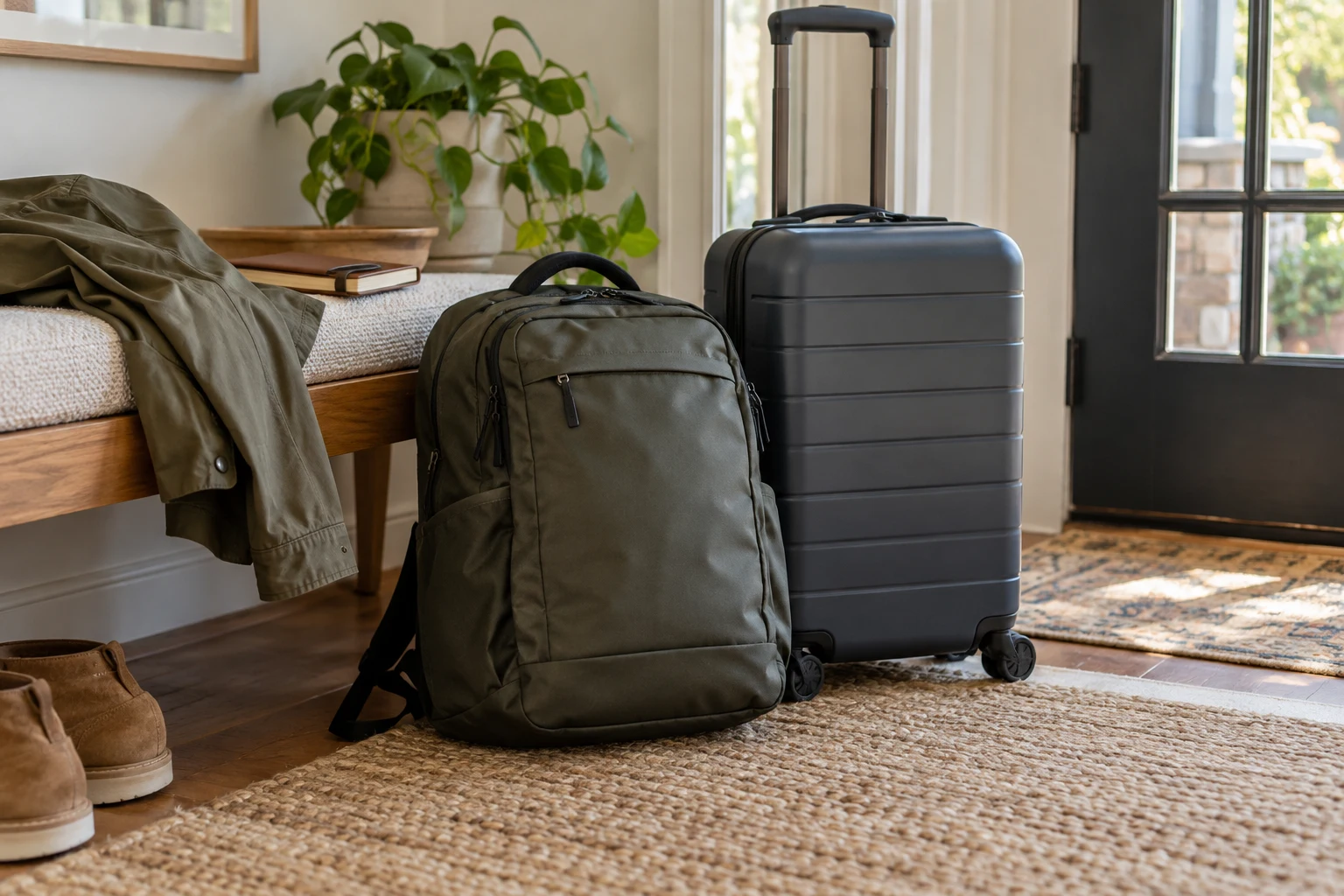
At a Glance
| Decision point | Useful choice | Trade-off to consider |
|---|---|---|
| Smooth travel route | Rolling case reduces carrying on suitable surfaces | Backpack remains fully carried |
| Stairs and narrow passages | Backpack moves with the traveler | Rolling case needs a manageable lifting plan |
| Changing load | Duffel offers flexible packing | Structured case offers a more fixed layout |
Choose for the journey you will actually make
The best travel bag is not necessarily the lightest, the most compartmentalized, or the one photographed beside a boarding gate. It is the bag that carries your normal load through the least convenient part of your journey without making the rest of the trip harder. Start by describing a representative trip: how you reach the airport or station, how far you walk, whether you use stairs, and where the bag will be stored at your destination. These details narrow the choice more effectively than a generic list of features.
A person moving between smooth terminal floors and a hotel lift may reasonably prefer wheels. Someone changing trains, climbing stairs, and crossing uneven pavements may value a backpack. A short car trip can favor a flexible duffel that fits an awkward space. None of these choices is universally superior. Consider the journey you repeat most often, then decide what inconvenience you are willing to accept on the occasional trip that differs.
Compare backpacks, rolling cases, and duffels honestly
A backpack keeps your hands available and moves with you through narrow spaces, but you carry its full weight. Strap shape, adjustment, the loaded depth, and the position of heavy items affect how it feels. A bag that is comfortable during a short fitting can become less appealing once packed for several days. Test it with a realistic load rather than judging comfort from padding thickness alone. A handle is also useful when briefly lifting the bag into storage or moving it through a tight space.
A rolling case transfers much of the carrying job to its wheels on suitable surfaces. The trade-off is handling stairs, curbs, crowded transport, and places where rolling is awkward. Check whether you can lift the loaded case using its actual handles. A duffel is often easy to pack and flexible around bulky items, but its shape and carrying style may make a long walk less convenient. Think about each format's weak point before being persuaded by its strongest marketing image.
Treat airline compatibility as a verification task
“Carry-on” is a product description, not a universal promise of acceptance. Before buying for air travel, check the current rules published by the airline for your route and fare. Look at dimensions, weight, and any separate personal-item allowance. Do not assume a bag accepted on a previous trip will meet every future requirement. If your trip involves different carriers, compare the applicable rules for each part rather than relying on the most generous one.
Measure the bag externally, including wheels, fixed handles, and any protruding pockets. A soft bag may expand when packed, while an advertised expandable capacity may take it beyond the dimensions you intended to use. Ask the seller for the exact model's external measurements if the listing is unclear. It is better to resolve uncertainty before ordering than to discover it when a bag is full. Recheck the airline's own guidance before departure, since product listings cannot maintain those rules for you.
Plan access in the order you need it
A travel bag has two jobs: transporting the load and letting you reach particular items at the right moment. Identification, travel documents, medication you need to carry, and a phone charger should not require a complete unpacking exercise. Decide which things must remain close to you and how you will retrieve them during the journey. A convenient pocket is useful only if it can be opened while the bag is in the position you normally carry or store it.
Clamshell openings can make clothing easier to arrange and inspect, especially when you unpack into accommodation. Top-opening designs may suit a changing load or a narrow place where a full clamshell opening is inconvenient. More pockets can improve separation, but they can also obscure where you put things and reduce flexibility for larger items. Choose an opening and a small number of meaningful compartments before being impressed by the total pocket count.
Evaluate comfort with the bag fully packed
Pack the clothing, shoes, electronics, and toiletries you normally take. Include the items that are easy to forget during a fitting, such as a water bottle or a coat. Wear or carry the bag for more than a brief lift. Walk through a doorway, turn in a confined space, and take it off without laying everything on the floor. Notice whether it swings, slips, catches your heels, or requires constant adjustment.
For a backpack, check that the available adjustments work for you and that the load does not force the bag into an awkward shape. For a shoulder bag, try the actual strap with the weight distributed as it would be on the trip. For a rolling case, test the handle at a comfortable height and check how it behaves when turning. These observations are more relevant than a universal comfort ranking because the same bag can work differently for different bodies and packing habits.
Inspect the parts that face repeated wear
Look beyond the fabric description. Check the handles, zipper operation, wheel arrangement, and the way heavily used parts attach to the bag. Read the manufacturer's care and repair information. Replaceable wheels or available parts may be useful for frequent travel, but verify that replacement parts are actually offered for the exact model. Do not infer easy repair from a photograph of visible screws or a general brand statement.
A warranty deserves the same practical reading. Check what it covers, what exclusions apply, and how a claim is made in your location. A long advertised term does not explain whether ordinary wear or a particular travel incident is covered. You are comparing the support available to you, not just a number in large type. For a less expensive occasional-use bag, a straightforward construction and a good initial fit may matter more than an elaborate support promise you are unlikely to use.
Check the empty weight and useful capacity together
Extra capacity is not free: it may bring a heavier bag, a less comfortable shape, or an invitation to pack more. Compare empty weights alongside dimensions and your expected contents. A lighter shell is useful only if it still provides the organization and handling you need. Likewise, a large capacity figure can conceal narrow corners, thick dividers, or an internal layout that fits your clothing poorly.
Try packing around the actual internal obstructions. Wheel housings and handle channels can affect how shoes or packing cubes fit. A laptop compartment may be convenient, but confirm its usable dimensions rather than relying solely on the laptop's advertised screen size. Leave some flexibility for the return journey. If the bag closes only when every item is positioned perfectly, a rushed hotel departure may be frustrating even when the first packing attempt looks impressive.
Use reviews to answer specific questions
Read reviews after identifying your likely problems. Search for accounts of stairs, rough surfaces, the same laptop size, or a similar trip length. Photos showing a packed bag can be informative if the reviewer explains the load. Separate complaints about an unsuitable size from recurring construction problems. Also check whether reviews cover the current version and the exact size you are considering; listings can combine several variants.
Do not let a star average substitute for this investigation. A traveler who uses a case twice a year may judge it differently from someone moving weekly. Both experiences can be sincere without predicting your own. Look for the conditions behind praise or criticism, then decide whether they resemble your journey. If the important dimensions or repair arrangements remain unclear, ask the seller or manufacturer rather than filling the gap with an optimistic assumption.
Worked example: a short trip with several transfers
Consider a traveler taking a taxi, two trains, and a short walk to accommodation for a three-night stay. The bag must be manageable on stairs and in narrow aisles, but it will also cover smooth station floors. Compare a realistically packed backpack with a rolling case rather than deciding that either format wins by definition. Notice the longest carrying stretch, the difficulty of lifting the case, and whether the backpack becomes uncomfortable with the laptop and clothing included.
The useful result may be a lighter load rather than a more sophisticated bag. Removing an unnecessary pair of shoes or simplifying duplicate accessories can change the comparison. Alternatively, a rolling case with a practical lifting arrangement may be preferable if carrying the full load is the main difficulty. Check the actual travel requirements and test the final setup at home. A decision based on the whole route is stronger than one based on the few minutes when either option is at its best. You are buying for a sequence of movements, not a single attractive airport scene.
Make the final test at home
Keep packaging and tags while you perform a realistic packing and carrying test within the seller's return conditions. Retrieve a document, remove your electronics, open the clothing section, and repack without a large clear floor. Check whether the bag stands or tips in the places you are likely to use it. A small irritation that appears immediately may become more annoying during a long travel day, so take that observation seriously.
Choose the bag whose compromises you can comfortably accept. A backpack that fits the route but becomes unpleasant when loaded is not a good match. A rolling case that carries beautifully but is difficult for you to lift also has a practical limit. The right purchase makes the whole journey manageable, not just the smooth section shown in an advertisement. If none of the shortlisted options works with your real load, adjust the packing plan or keep looking rather than buying capacity you cannot comfortably move.
Questions & Answers
Is a backpack always better for travel with stairs?
A backpack keeps the load with you, but its full packed weight must be carried. Compare that burden with lifting a rolling case on the actual route. Test both with your normal belongings.
Does a carry-on label guarantee airline acceptance?
No. Check the airline’s current rules for your route and fare, then compare the bag’s external dimensions and packed weight. Include wheels, fixed handles and any expansion when assessing the fit.
How can I test a bag before a trip?
Pack a representative load, walk through doorways, retrieve travel essentials and rehearse repacking in a limited space. Follow return conditions and keep the packaging while checking whether the compromises suit you.