Travel
Are Packing Cubes Worth It? A Practical Guide to Choosing and Using Them
At a Glance
| Decision point | Useful choice | Trade-off to consider |
|---|---|---|
| Multi-stop trip | Broad removable groups | Highly specific outfit groups only when the itinerary supports them |
| Space | Templates matching the real suitcase interior | A large mixed set chosen by piece count |
| Compression | Less bulk when the packed shape remains useful | Do not mistake reduced bulk for reduced weight |
Decide what packing cubes are supposed to improve
Packing cubes can make a suitcase easier to understand. They separate clothing, hold a group together, and let you remove part of the contents without disturbing everything else. They do not automatically make a bag lighter or turn an unsuitable suitcase into the right one. Start by identifying the frustrating part of your current packing routine. If you lose small items, a small visible compartment may help. If clothes spread across the case after one night, a few larger groups may be more useful.
Think about how you travel after arrival. A person staying in one hotel and unpacking into drawers has different needs from someone opening a bag at several short stops. For the first, cubes may mainly help on the journey. For the second, they can act as movable drawers throughout the trip. Choose a system for that behavior rather than copying a layout that looks satisfying only before departure.
Measure the suitcase interior before choosing a set
Use the suitcase's usable interior measurements, not its outside dimensions. Wheel housings, handle channels, curved corners, and fixed dividers can reduce the area available to rectangular cubes. Open the case as you normally would and mark the spaces that are genuinely easy to fill. Consider whether the two halves have different depths. A cube that fits beautifully in one side may leave the other side difficult to close.
Cut paper templates to the proposed cube footprints and arrange them in the suitcase. Leave a flexible area for shoes, a jacket, or objects that do not fit naturally into a cube. Check the height as well as the base. This exercise can show that a smaller collection of useful sizes works better than a large assortment. It also prevents you from treating every leftover corner as a problem that requires another specially shaped accessory.
Group clothing by the way you retrieve it
There are several sensible ways to group a load. You might separate tops, bottoms, and small items, or arrange complete outfits for particular stages of the trip. Neither is automatically more organized. Choose the approach that lets you retrieve what you need with the least unpacking. If you dress according to changing weather or activities, rigid outfit bundles may be inconvenient. If each stop has a clear purpose, they may work well.
Start with a few broad groups and adjust after a real trip. Too many narrowly defined cubes can make you search among similar pouches, while one very large cube may merely reproduce the original pile. Consider what happens when some clothing has been worn and the original groups shrink. A good system remains understandable halfway through the journey, not just when every item is clean and folded into its assigned place.
Understand standard and compression formats
A standard cube primarily contains and separates clothing. A compression design usually adds a mechanism intended to reduce the packed bulk of suitable soft contents. That may be helpful, but the compressed shape matters. A densely filled cube can become firm or rounded, making it less adaptable around the suitcase's internal frame. Judge the resulting package rather than assuming that a smaller-looking cube always creates more useful luggage space.
Compression does not change the weight of what you packed. It may make it easier to fit additional items and therefore easier to exceed a weight allowance. Check your complete packed bag against the rules relevant to your trip. Also consider whether you are comfortable operating the compression zipper without strain. If closing the cube requires forcing the fabric together, a smaller load or a different arrangement may be more practical than a more aggressive packing technique.
Compare visibility, structure, and fabric care
A visible panel can help you identify contents, especially when several cubes are similar. An opaque design can be useful for keeping personal items out of view in a shared room. Fabric weight, shape, and the way a cube stands when opened affect how it works as a temporary drawer. A highly structured cube may be easy to handle but less flexible around awkward objects. Choose the balance that suits your luggage and unpacking habits.
Read the care instructions for the exact product. Do not assume that every lightweight fabric cube is machine washable or suitable for the same drying method. Inspect the interior corners and seams to understand how you will clean it after a spill. A travel organizer that is difficult to dry or reset can become another job at the end of the trip. Simpler construction is often easier to understand, although the right choice depends on your intended contents.
Keep dirty and damp items out of the clean-clothes system
Plan where worn clothing will go before leaving home. A separate laundry bag can prevent it from spreading through clean items, but the size should match the likely load and the way you will transport it. Do not assume an ordinary fabric cube is a waterproof barrier. Check any specific claims and follow the product's care guidance. Items that need drying should be handled appropriately rather than sealed indefinitely because a spare compartment happens to be available.
The laundry arrangement should be flexible. On a longer trip, clean clothing gradually moves into the worn group, so a fixed set of equally full cubes may stop making sense. You might keep one empty flexible bag that grows as the clean groups shrink. The important question is whether you can identify what remains ready to wear without unpacking everything. A simple separation plan can contribute more than buying a large set with many duplicate sizes.
Pack shoes and awkward objects deliberately
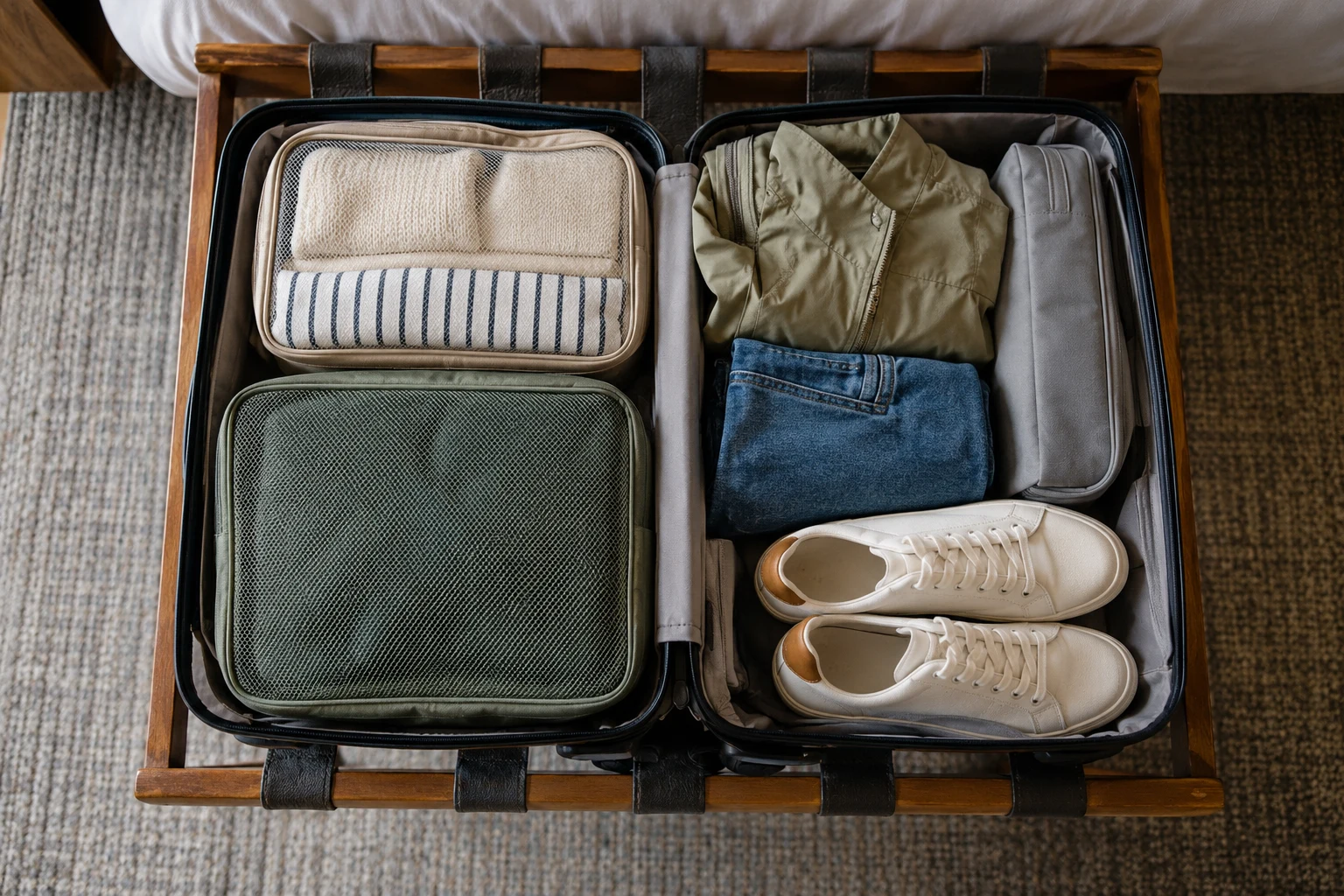
Shoes, a toiletry bag, a hair tool, or a light jacket may not suit the rectangular layout created by cubes. Leave space for them instead of forcing every object into the same format. Consider how the suitcase closes and where pressure is likely to occur. A neatly filled cube should not encourage you to crush something beside it or make the case depend on a very precise arrangement that is difficult to repeat.
If you use a separate shoe bag, check its loaded dimensions within the whole suitcase. One accessory can consume the space another accessory was intended to save. The same applies to large toiletry organizers. Compare the combined system with your actual trip contents. You may discover that fewer cubes and one flexible area provide easier access than a fully tiled interior. Useful packing leaves room for variation between the outward and return journeys.
Buy the useful sizes, not the biggest piece count
A set containing many pouches can appear economical while providing only a few sizes you will regularly use. Write down the groups you need and the dimensions that fit your bag before comparing sets. Check whether the advertised piece count includes laundry bags, shoe bags, or very small pouches. Those pieces may be useful, but they should be evaluated as separate functions rather than treated as interchangeable cubes.
Consider whether you can buy an individual size later, while recognizing that ranges and availability can change. Starting with a modest set allows you to learn what works before committing to a complete matching system. A low price per item is not especially valuable when the unused pieces occupy another drawer at home. Compare the cost of the arrangement you expect to use, including any separate bag needed for laundry, rather than the apparent generosity of the bundle.
Perform a realistic unpack-and-repack test
Pack for a specific trip, close the suitcase, and move it to another room. Open it in a limited area, retrieve one change of clothes, and close it again. Then imagine a rushed departure: put the clothing back without carefully recreating every fold. If the layout works only with ample floor space and considerable patience, adjust it. The system should reduce effort when you are tired, not demand a more elaborate routine.
After the first journey, note which cubes stayed useful and which became redundant. Remove pieces that did not solve a problem. If a cube was repeatedly overfilled, change the grouping before assuming you need a larger one. If you could never tell two cubes apart, add a simple identifying method. Small adjustments based on use are more dependable than copying someone else's exact packing list, because your clothing, luggage, and activities are different.
Worked example: five nights in three places
For a trip with several short stops, arrange the first night's clothing so it can be removed without opening every cube. Keep the remaining clean groups easy to identify and give worn clothing a flexible separate place. Rehearse that sequence with the suitcase on a small bench rather than spread across a large floor. If the cubes can be moved as useful groups, they are serving the trip. If they need to be opened and rearranged at each stop, simplify the categories.
On the return journey, the original arrangement may no longer be ideal. Some clothing is worn, small items have moved, and a jacket may need to be accessible. Leave room for that change instead of treating the outward layout as a permanent rule. A few broad cubes can remain useful as the proportions shift. This is the practical advantage of containment: not preserving a perfect packing photograph, but making the changing contents of a bag easier to understand throughout the journey.
When cubes are worth buying
Choose packing cubes when containment and access are clear problems in your existing bag. A few well-chosen pieces can make multi-stop travel easier and help a shared suitcase remain understandable. Choose a simpler arrangement if you already pack a small load, unpack completely on arrival, or find that extra containers make your luggage rigid and crowded. The goal is a system that survives ordinary use. A suitcase that is easy to open, understand, and close again is more useful than one that looks perfectly compartmentalized for a single photograph.
Questions & Answers
Do compression cubes reduce luggage weight?
They do not remove the weight of the packed contents. They can change bulk and shape, which may make it easier to add more items. Check the complete bag against the travel requirements that apply to you.
Should every item go inside a cube?
No. Leave flexible space for shoes, a jacket or awkward objects. Cubes are useful when they improve containment and retrieval, not when they force every object into an unsuitable rectangular format.
How many cubes should I start with?
Begin with a few broad groups that fit your actual suitcase and unpacking routine. Review the arrangement after a trip before buying a larger matching system or more narrowly defined compartments.